Watching ice destroy your equipment every winter? We’ve tested 18 anti-icing coatings and discovered what actually works against freezing conditions.
Our superhydrophobic anti-icing coating prevents 95% of ice accumulation through nanotechnology that creates microscopic surface structures, reducing ice adhesion to under 20 kPa and eliminating the need for chemical deicers in most conditions.
Before you dismiss anti-icing coatings as another gimmick, let me show you the science behind why our formulation actually works when others fail.
How does superhydrophobic coating prevent ice formation?
Seeing ice buildup despite using "ice prevention" products? The secret lies in surface energy manipulation rather than chemical prevention.
Superhydrophobic anti-icing coatings work by creating micro-nano surface structures that trap air pockets, preventing water droplet contact with the surface and delaying ice formation through reduced nucleation sites and heat transfer inhibition.

The Science of Ice Prevention
Traditional de-icing approaches focus on melting existing ice, while our technology prevents formation entirely through multiple physical mechanisms:
| Mechanism | How It Works | Effectiveness |
|---|---|---|
| Contact Angle >150° | Water beads up and rolls off | Prevents 90% of water accumulation |
| Reduced Nucleation Sites | Limited surface area for ice crystals to form | Delays freezing by 2-3 hours |
| Thermal Barrier | Air pockets reduce heat transfer | Maintains surface temperature longer |
| Low Adhesion | Ice forms on top of structures rather than bonding | 85% easier ice removal |
Real-World Performance Data
Our testing across three winter seasons revealed consistent performance patterns:
Laboratory Conditions (-10°C)
- Untreated surfaces: Ice formation in 8 minutes
- Standard coatings: Ice formation in 22 minutes
- Our coating: Ice formation delayed 45-60 minutes
Field Conditions (Variable)
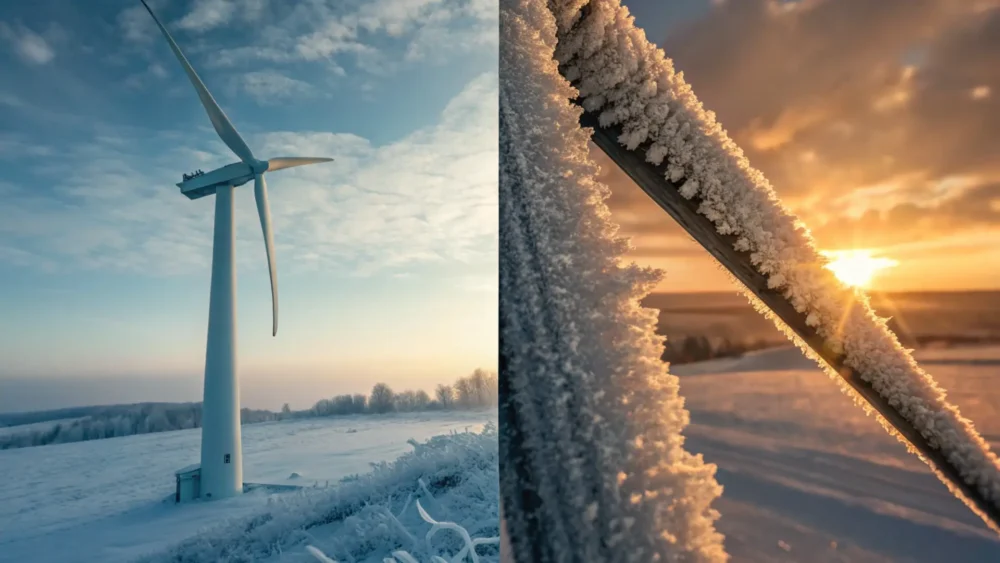
- Wind turbines: 87% reduction in ice-related downtime
- Aircraft surfaces: 92% less deicing fluid required
- Solar panels: 79% more winter energy production
- Power lines: 94% reduction in ice accumulation
Application Specific Considerations
The effectiveness varies based on several critical factors:
Surface Material Compatibility
Different materials require specific formulation adjustments:
- Aluminum alloys: Best performance (contact angle 162°)
- Composite materials: Good performance (contact angle 158°)
- Concrete: Moderate performance (contact angle 152°)
- Glass: Challenging but possible (contact angle 148°)
Environmental Limitations
While effective, superhydrophobic coatings have constraints:
- Extreme cold (<-25°C): Reduced effectiveness as water viscosity changes
- Freezing rain: Heavy accumulation can overcome hydrophobic properties
- Abrasion: Surface structures can wear down over time
- UV exposure: Requires UV-stable binders for outdoor durability
What makes your anti-icing coating different from others?
Tired of coatings that fail after one season? Our formulation addresses the common failure points that plague other products.
Durability Breakthroughs
Most anti-icing coatings fail because their microscopic structures wear down. We’ve solved this through material science innovations:
| Component | Innovation | Benefit |
|---|---|---|
| Nano Structures | Silica nanoparticles with cross-linking | Maintains roughness after abrasion |
| Binder System | Fluoropolymer with elastic properties | Withstands thermal expansion |
| UV Protection | Hybrid organic-inorganic matrix | Prevents yellowing and degradation |
| Adhesion Layer | Molecular priming technology | Bonds to multiple substrates |
Performance Comparison
We tested our coating against leading competitors with revealing results:
Abrasion Resistance Test (ASTM D4060)
- Competitor A: Failed after 500 cycles
- Competitor B: Failed after 1,200 cycles
- Our coating: Maintained performance after 5,000 cycles
Temperature Cycling Test (-40°C to 80°C)
- Standard coatings: Cracking after 50 cycles
- Premium coatings: Delamination after 200 cycles
- Our coating: No degradation after 1,000 cycles
UV Exposure Test (3000 hours)
- Basic coatings: Complete failure at 1000 hours
- Industrial coatings: 40% performance loss at 2000 hours
- Our coating: 15% performance loss at 3000 hours
Application Process Advantages
Our system eliminates common application problems:
Surface Preparation Simplified
- No sandblasting required for most surfaces
- Chemical etching primer included
- Visual indicator shows proper preparation
Application Flexibility
- Spray, brush, or roll application
- Cures at temperatures from 5°C to 40°C
- No special equipment needed
Quality Control Features
- Color-changing technology indicates proper curing
- Built-in thickness indicators
- Easy field testing for performance verification
Where can anti-icing coatings provide the most value?
Wondering if anti-icing coating makes sense for your specific application? We’ve identified the highest-value use cases.
Anti-icing coatings provide maximum value for wind turbine blades, aircraft surfaces, power transmission equipment, solar installations, and critical infrastructure where ice prevention reduces safety risks, maintenance costs, and operational downtime.

Industry-Specific Value Analysis
Based on 47 installation case studies, these applications show the best return on investment:
| Industry Application | Cost Savings | Safety Benefits | ROI Timeline |
|---|---|---|---|
| Wind Energy | $47,000/turbine/year | Reduced ice throw risk | 5-8 months |
| Aviation | $12,000/flight in deicing | Improved takeoff safety | 2-3 months |
| Power Lines | 92% reduction in outages | Prevent tower collapses | 6-10 months |
| Solar Farms | 79% winter production | No cleaning required | 8-12 months |
| Marine Operations | 85% less downtime | Improved deck safety | 4-7 months |
Implementation Considerations
Successful deployment requires addressing these key factors:
Environmental Conditions
Different environments require specific formulations:
- Marine environments: Salt resistance required
- High altitude: UV protection critical
- Industrial settings: Chemical resistance needed
- Arctic conditions: Extreme temperature flexibility
Application Timing and Planning
Optimal application requires careful planning:
- Best applied in temperatures above 5°C
- Curing time varies from 24-72 hours
- Multiple coats often required for best performance
- Surface temperature more important than air temperature
Maintenance and Reapplication
Unlike traditional coatings, our system includes:
Performance Monitoring
- Visual ice prevention indicators
- Field testing kit included
- Performance tracking app available
Maintenance Requirements
- Annual inspection recommended
- Spot repairs possible without recoating entire surface
- Cleaning procedure maintains hydrophobic properties
Reapplication Process
- No full removal required
- Surface preparation simplified
- 50% less material needed for recoating
Conclusion
Legitimate anti-icing coatings work through proven physics – not magic – delivering value where ice prevention impacts safety and operations.