What is the best thing to clean solar panels with? (Spoiler: It’s Not What You Think)
Dirty solar panels are silent money thieves. I lost over $1,200 in a single year because dust and grime stole 25% of my power. Like most people, I started with the “common wisdom”: soft water, a soft brush, and a drop of Dawn dish soap.
It worked… until I did the math. The endless cycle of climbing, scrubbing, rinsing, and repeating wasn’t a solution—it was a costly hobby. The real best thing to “clean” your solar panels with isn’t a thing you apply each time. It’s a one-time application of a hydrophilic self-cleaning coating that lets rain do the work for a decade.
Keep reading. I’ll show you why the old methods are a trap, and how a permanent coating saved me time, money, and my Saturday mornings.
The Conventional Wisdom: Water, Soap, and Elbow Grease
Yes, you can clean solar panels with deionized water and a tiny amount of mild, pH-neutral soap like Dawn. Manufacturers approve it because it’s low-risk. It’s the method I used for years, and it’s infinitely better than using hard water, vinegar, or a pressure washer.
But let’s be brutally honest about this “best practice”:
The Hidden Costs of “Safe” Cleaning
| Cost Factor | The Reality |
|---|---|
| Your Time | 2-4 hours, twice a year. That’s a full day every year, forever. |
| Water & Equipment | Deionized water systems, soft brushes, squeegees—an upfront investment of $150-$300. |
| Performance Rollercoaster | Output jumps after cleaning, then immediately begins decaying. You’re averaging 10-15% soiling loss. |
| Safety Risk | Climbing on a roof is dangerous. Slipping or dropping tools can cause injury or panel damage. |
This method doesn’t solve dirt; it manages it through recurring effort. It’s like using a bucket to bail water from a leaky boat instead of fixing the hole.
The “Quick Fix” Traps You Must Avoid
Before I found the real solution, I fell for every “miracle” shortcut. Don’t make my mistakes.
❌ Vinegar: The “Natural” Panel Killer
Acetic acid slowly degrades the anti-reflective coating and seals. My neighbor’s panels have permanent, production-killing streaks from vinegar. Verdict: Never use it.
❌ Pressure Washers & Abrasives: The Instant Void
High pressure cracks seals, forcing moisture into the module. Abrasive pads scratch the glass. Both will void your warranty instantly. Verdict: Never use them.
❌ Hard Water & Harsh Chemicals: The Slow Poison
They leave mineral deposits and chemical residues that bake onto the glass, creating permanent, light-blocking films. Verdict: Only use deionized water and approved cleaners.
The painful truth? Even if you do everything “right” with the conventional method, you’re still signing up for a lifetime of maintenance and suboptimal performance.
The Paradigm Shift: From Cleaning to Self-Cleaning
The breakthrough came when I stopped asking “What’s the best thing to clean with?” and started asking “How can I make my panels clean themselves?”
The answer is a hydrophilic (water-loving) nano-coating.
How It Works: Letting Physics Do the Work
-
Applied once by a professional, it bonds permanently to the glass.
-
It creates an ultra-smooth, high-surface-energy layer.
-
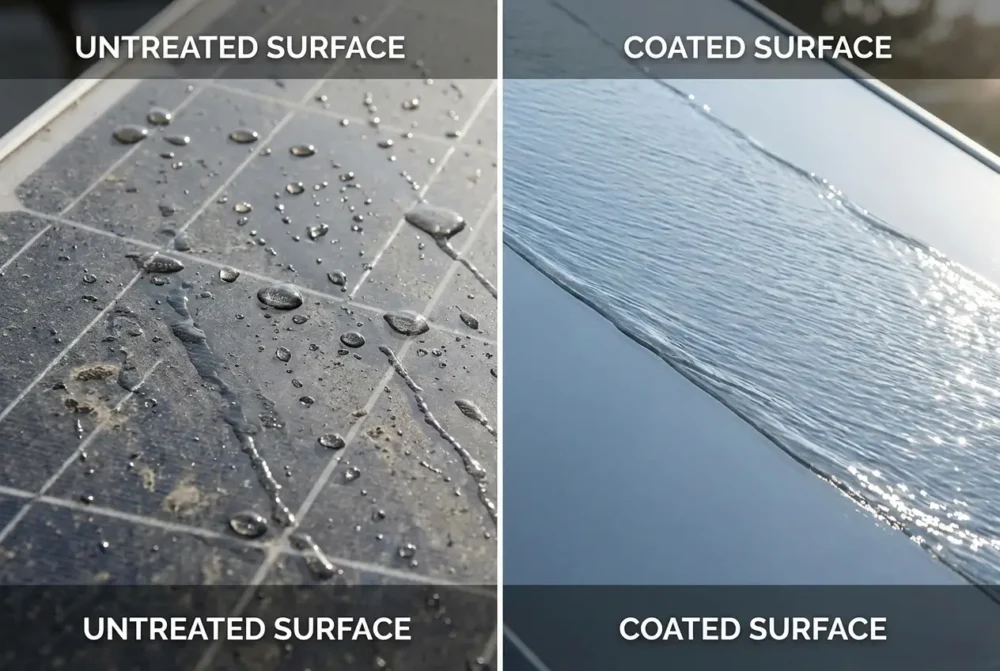
When water hits it (rain, dew), it sheets off in a thin, continuous film, instead of beading.
-
This sheeting action drags away dust, pollen, and bird droppings effortlessly.
You’re not cleaning anymore. You’re harnessing the weather.
My Data: The Proof Is on My Roof (And My Bill)
I had a professional-grade hydrophilic coating applied to my 28-panel system. Here’s the one-year comparison:
| Metric | The Old Way (Dawn + DI Water) | The New Way (Hydrophilic Coating) | Improvement |
|---|---|---|---|
| Annual Cleanings | 4 times | 1 light rinse (optional) | -75% Effort |
| Total Annual Time | 8 hours | 10 minutes | -98% Time |
| Average Soiling Loss | 12-18% | 1-3% | +15% Output |
| Annual Water Use | 200+ gallons | \~20 gallons | -90% Water |
| Mental Tax | “I need to clean the panels.” | “The rain just cleaned my panels.” | Priceless |
The financial impact: The extra 15% production nets me about $1,000 more per year. The coating paid for itself in under 8 months. Now, it’s pure profit for the life of the system.
“But What About…?” Your Questions, Answered
Q: Does it void my warranty?
A: No. Reputable coatings are certified for solar glass and often come with their own 5-10 year warranty. They protect the glass. Always use a certified installer and choose an insured product.
Q: Can I apply it myself?
A: I don’t recommend it. Professional application ensures perfect surface preparation, even coverage, and curing—all critical for long-term performance. This is a 20+ year investment; get it done right.
Q: What if it rains before it cures?
A: Professional installers monitor weather and use fast-curing formulations. This is another reason to hire a pro.
Q: Is it worth it for a small home system?
A: Absolutely. The time savings and safety benefit alone are worth it for most homeowners. The increased production pays for the coating many times over.
The Verdict: What’s Truly the “Best Thing”?
-
The best temporary cleaner is deionized water with a drop of Dawn.
-
The best permanent solution is a hydrophilic self-cleaning nano-coating.
The first option treats a symptom. The second option solves the disease.
For three years, I’ve watched rain and dew keep my panels at near-peak performance. I’ve reclaimed my weekends. I’ve stopped worrying about pollen season or bird activity. The coating isn’t just a product; it’s freedom from maintenance.
Ready to Stop Cleaning and Start Earning?
If you’re tired of the endless cycle and ready to invest in a permanent solution, the path is simple:
-
Get a Quote: Contact a certified installer of professional-grade hydrophilic coatings.
-
Verify: Ensure they offer a long-term warranty, insurance, and lab test reports (look for a contact angle <10°).
-
Enjoy: After a one-day application, let nature handle the rest.
Stop asking what to clean with. Start asking how to never clean again.
Want to see the coating in action? [Watch my YouTube video] where I demonstrate the incredible sheeting effect on my own panels during a rainstorm.